What Are the Penis Types and Penis Shapes?
Did you know there are different types of penises, each with a unique shape?
Generally, differences in length, thickness (girth), curvature, direction, size and elasticity are genetically determined and do not interfere with health or sexual performance.
That’s why as a urologist with over 25 years of experience in men’s sexual health I can assure you that no man should feel ashamed or inferior because of the appearance of his genitals.
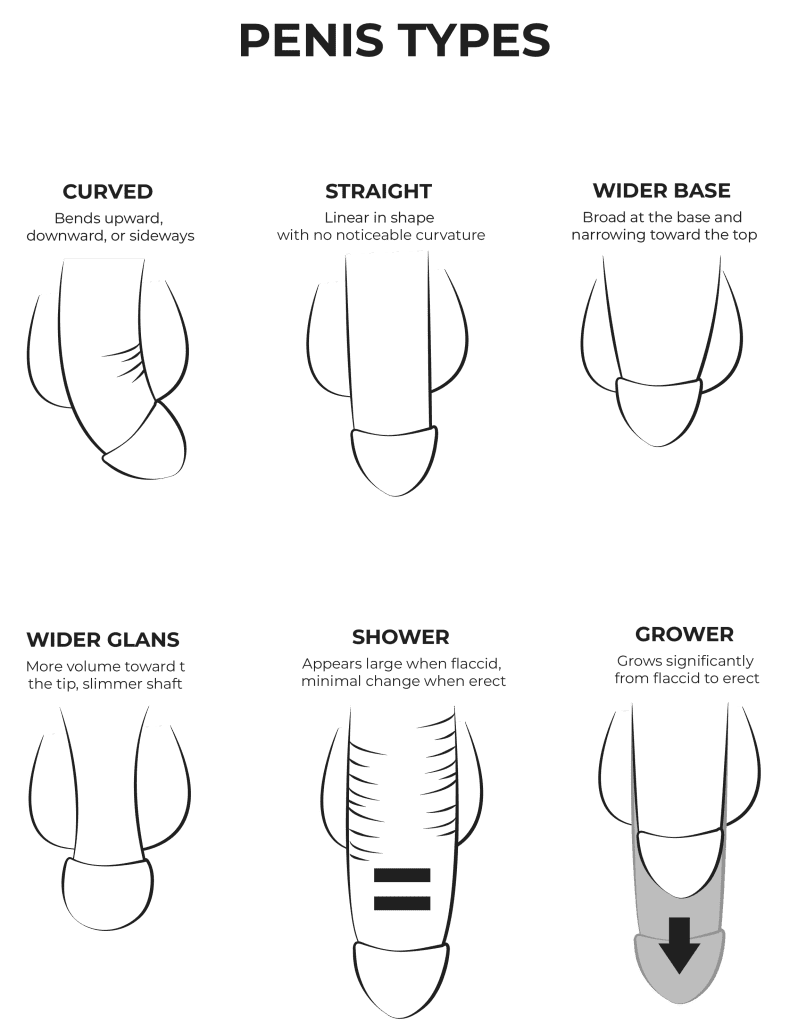
In this blog post on male anatomy we’ll explain the most common types of penises to help demystify the topic. You may even identify the general type of penis you have based on our brief descriptions.
So, do you have a wider base, wider glans or consistent up and down? Are you a “grower” or a “show-er”?
Keep reading to find out!
What Are the Most Common Types of Penises?
It’s natural to have concerns about the penis—it’s closely linked to health and sexuality.
Additionally, its appearance often impacts male self-esteem.
Because of this, many men wonder whether their penis has a “normal” shape. While penises share a similar structure (shaft, head, and base), they can vary greatly in size, direction, and elasticity.
Some are straight, others are curved. Some are wider at the base, others at the tip. Some grow significantly when erect, others less so.
Let’s explore the most common types of penis:
Straight Penis
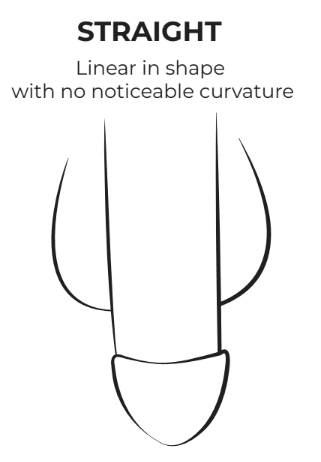
The straight penis shape has no noticeable curvature and appears linear, like a stick. Its size is usually proportional and may be either thin and short or thick and long.
Its proportions can vary widely. For example, some are shorter and slimmer, while others are longer and thicker. This type is often perceived as the “standard” shape because of its symmetry, but it is just one of many natural variations.
The straight penis type is generally considered the most common type. However, studies suggest that mild curvature in some direction is also very widespread, so while a straight penis may be seen as the “default,” it isn’t necessarily more “normal” or more healthy than the other shapes.
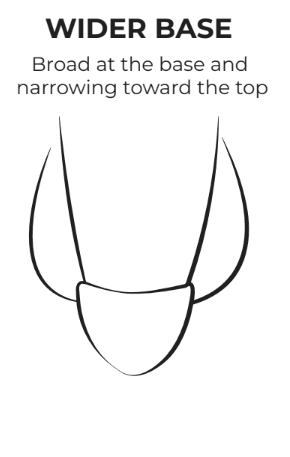
Penis with a Wider Base
This type of penis starts thicker at the base and narrows toward the glans (head), giving it a cone-like shape.
The wider foundation can give the appearance of extra fullness where the shaft meets the body, while the tapering toward the head often makes penetration feel different compared to a uniformly shaped penis.
Like other natural penis type variations, this shape is normal and simply reflects individual anatomical differences.
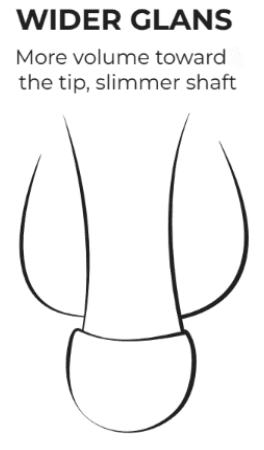
Penis with a Wider GlansHere, the shaft is thinner and gradually thickens toward the glans. There is more volume towards the tip with a slimmer shaft. Its shape can resemble an eggplant or mushroom. This variation is completely normal and is often noted for the pronounced head, which may provide unique sensations for both partners during sexual activity. |
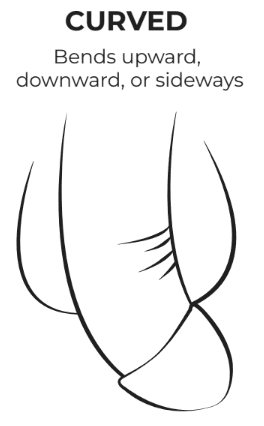
Curved Penis
A curved penis may bend upward, downward, or sideways, similar to a banana.
The degree and direction of the curve vary from person to person.
Some men with a curved penis type may have peyronie’s disease, a condition our urology team treats in Miami.
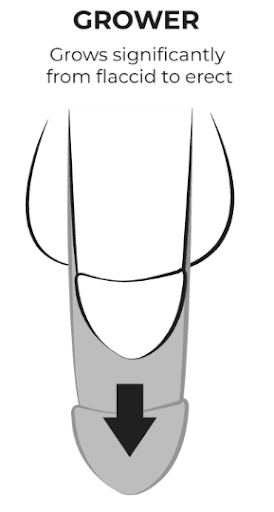
Grower Penis
The term “grower” refers to a penis that appears small when flaccid but grows significantly when erect.
This change can be quite dramatic, with some men experiencing a significant increase in both length and girth during arousal.
Being a grower is completely normal and simply reflects natural differences in how penile tissue expands with increased blood flow.
Shower Penis
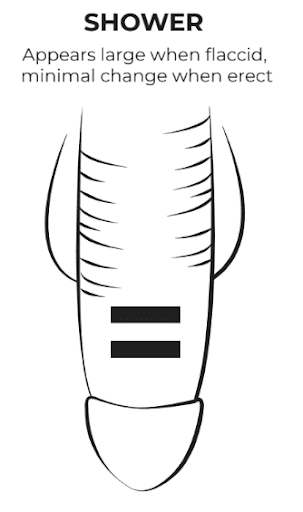
A “shower”(SHOW-er) is a penis that looks large when flaccid but doesn’t change much in size when erect due to having less elasticity.
While the change during arousal may be less dramatic, a shower is just as normal as a grower and simply reflects a different way the penis responds to blood flow.
Both types are healthy variations of male anatomy.
What Is the Average Penis Size?
Globally, the average erect penis measures 12–14 cm (4.7–5.5 in) in length and about 3 cm (1.2 in) in diameter. When flaccid, the average is around 9 cm (3.5 in) long and 2 cm (0.8 in) wide.
These measurements are taken from the pubic bone to the tip of the glans, using the widest point for diameter.
See our tips on how to measure your penis.
Do Penis Shape and Size Affect Sexual Function?
In rare cases, penis shape or size can affect sexual function or pleasure. This includes conditions such as micropenis, severe curvature from Peyronie’s disease, or buried penis.
- Micropenis is diagnosed when an erect penis is more than 2 standard deviations below the average—typically 7 cm (2.75 in) or less in length.
- Peyronie’s Disease involves fibrous scar tissue that causes significant curvature (30 to 90 degrees) of the erect penis, which can make penetration difficult or even impossible. Learn more about Peyronie’s Disease.
- Buried Penis is a rare condition, mostly seen in children but occasionally in adults, where the penis is normal in size but hidden by pubic tissues or adhesions, often related to phimosis.
When Should You Seek Help for Penile Aesthetics?
Unless a disease is present, the natural variations in penis type don’t affect sexual function.
However, if your penis is significantly below average, it’s worth consulting a specialist to investigate and potentially begin penis enlargement treatment. The same applies to those within the average range who still feel dissatisfied with the size or appearance of their genitals.
And remember, there are many non-doctors practicing penile enhancement techniques. Only UroFill® is FDA approved and has years of success behind it.
Still have questions? Get in touch—the UroFill® team is here to help!
Contact Us
UroFill Clinic Form - GF
Initial general contact form for UroFill Clinic inquiries